
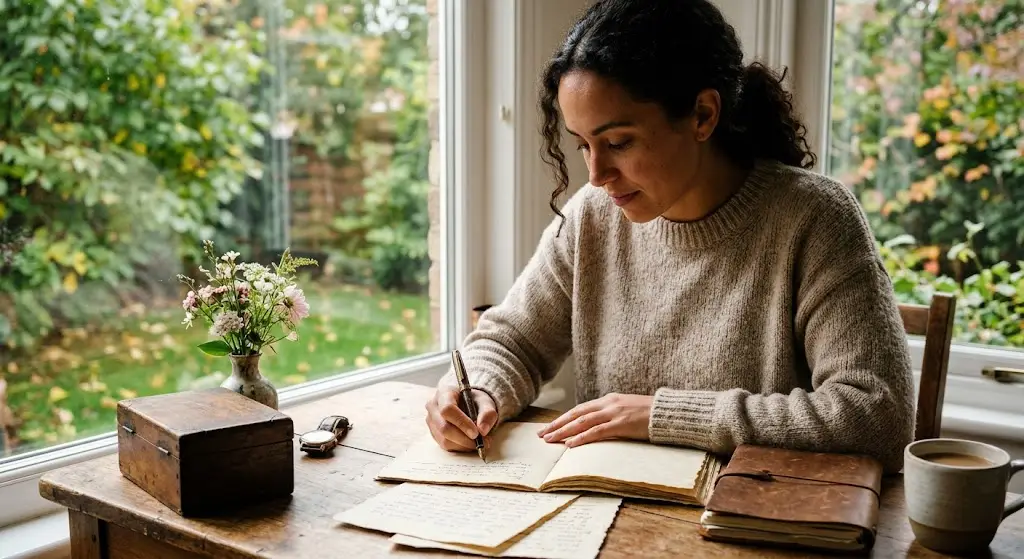
How to Write a Love Letter That Comes From the Heart
When was the last time you put your feelings for someone into words without worrying about how quickly they would read them?
Not a text sent between errands. Not a quick message before bed. Not a comment on a photograph or a short expression of affection in the middle of a busy day.
A real letter.
Something written with care, where you have time to think about what you want to say and the person receiving it has something meaningful to return to.
There is something special about a love letter. It allows us to slow down and give our feelings the attention they deserve. We can choose our words carefully, remember the moments that brought us together, and express things that might feel difficult to say aloud.
Yet many people hesitate when they sit down to write one.
They wonder where to begin, how romantic their words should be, or whether their writing will sound awkward. Some believe they need to be naturally poetic to create something worth keeping.
The truth is much simpler.
You don’t need perfect grammar, elaborate metaphors, or extraordinary writing skills to write a meaningful love letter. You need honesty, a little reflection, and a willingness to let another person see what they mean to you.
The most memorable love letters aren’t necessarily the most beautiful ones.
They’re the ones that feel personal.
Why Love Letters Still Matter
We live in a world where communication is immediate.
We can send a message in seconds, share a photograph instantly, or tell someone we’re thinking about them with a few words on a screen.
These everyday forms of communication have their place. A thoughtful text can brighten someone’s morning, and a quick phone call can make a difficult day feel easier.
But a handwritten or carefully composed love letter offers a different experience.
It creates a moment of intentional attention.
Instead of communicating only what is necessary in the moment, you have the opportunity to explore what someone means to you and why your connection matters.
A letter can also become something tangible to revisit.
Your partner might read it on an anniversary, keep it beside a favorite book, or return to it during a difficult week. The words remain available long after the moment in which they were written.
Over time, a collection of letters can become a record of a relationship: what you appreciated about each other, what you experienced together, and how your feelings developed.
A love letter doesn’t have to compete with modern communication.
It offers something different: a deliberate expression of affection that someone can experience at their own pace.
1. Start With What You Actually Feel
One of the biggest challenges in writing a love letter is knowing how to begin.
You might sit in front of a blank page, thinking that the first sentence needs to be unforgettable.
That expectation can make writing unnecessarily difficult.
Instead of searching for a perfect opening, begin by asking yourself a simple question:
What do I most want this person to know?
Perhaps you want them to understand how much you appreciate their presence in your life. Maybe you’re thinking about a particular memory, something they’ve done for you, or a quality you admire but don’t mention often enough.
Start there.
You could write:
“I’ve been thinking about how much my life has changed since you became part of it.”
Or:
“There is something I’ve wanted to tell you for a while, and I thought it deserved more than a quick message.”
You could even begin with something as simple as:
“I don’t always find the right words when we’re together, but I want you to know what you mean to me.”
These openings don’t rely on complicated language. They create a natural starting point for expressing something personal.
Don’t worry about making the first draft perfect.
Write what comes to mind, then return to it later. Often, the most genuine sentence appears after you stop trying so hard to sound romantic.
2. Make Your Letter Personal With Specific Details
A general expression of love can be beautiful, but specific details make a letter feel uniquely connected to the person receiving it.
Consider the difference between saying, “You’re an amazing person,” and explaining exactly what you admire about them.
Perhaps you love how they remember the little things you mention. Maybe they remain patient when everyone else feels frustrated, or they have a way of making ordinary situations feel lighter.
You could write:
“I love the way you remember things I mention in passing. It makes me feel that you’re listening, even when I don’t realize how much something matters to me.”
That sentence tells the reader something about both of you. It describes a quality you appreciate and explains why it matters.
Think about the details that make your partner who they are.
- What little habit makes you smile?
- What quality do you admire most?
- When have they made you feel especially supported?
- What do they do that makes an ordinary day better?
- What is something about them you hope they never stop doing?
Choose one or two details and explore them.
You don’t need to list every reason you love someone. A single, carefully described example can feel more meaningful than a page of general compliments.
The goal is to help the other person recognize themselves in your words.
3. Bring a Shared Memory Into the Letter
Shared memories are powerful because they belong to the two people who experienced them.
A first date, an unexpected adventure, a quiet evening at home, or a difficult moment you worked through together can all provide inspiration.
You don’t have to choose the biggest event in your relationship.
Sometimes, a small memory carries the most meaning.
Perhaps you remember laughing together over something that wasn’t particularly funny to anyone else. Maybe you remember the first time you realized you could be completely yourself around this person.
Describe the moment in enough detail to bring it back to life.
What were you doing? What made it memorable? What did you notice about the other person? How did you feel afterward?
For example:
“I still remember that evening when we sat talking long after we had planned to leave. Nothing extraordinary happened, but I remember feeling that I didn’t want the conversation to end.”
The value of this memory isn’t that it sounds dramatic. It’s that it reveals something about your experience of the relationship.
You can also explain why the memory still matters.
Perhaps it reminds you of how comfortable you feel together, how much you’ve learned about one another, or how a seemingly ordinary moment became an important part of your story.
When you include shared experiences, your letter becomes more than a declaration of love. It becomes a reflection on the life you’ve already created together.
4. Explain How This Person Makes You Feel
Love letters become especially meaningful when they go beyond describing the person you love and explain what your connection means to you.
Think about the emotions you experience when you’re with them.
Do you feel understood? Encouraged? More confident? Comfortable enough to be honest about things you usually keep private?
Perhaps you feel a sense of calm when you hear their voice after a difficult day. Maybe their encouragement helps you approach challenges differently, or their presence reminds you that you don’t have to handle everything alone.
Try to put those experiences into words.
You might write:
“One of the things I appreciate most about being with you is that I don’t feel the need to pretend I have everything figured out. I can tell you when I’m uncertain, and that makes our connection feel especially important to me.”
Notice that the emphasis is on your personal experience rather than an exaggerated claim about the other person’s importance.
You aren’t required to say that someone has completed your life or made every problem disappear.
You can simply explain how their presence has affected you.
Specific emotional honesty often feels more intimate than dramatic declarations because it reveals something real about the way you experience the relationship.
5. Don’t Be Afraid to Be Vulnerable
Writing about love can feel surprisingly uncomfortable.
You may worry that your feelings sound too intense, that your words reveal too much, or that the other person won’t respond in the way you hope.
Those concerns are understandable.
A love letter involves expressing something personal without having complete control over how it will be received.
You don’t need to reveal every private thought or make yourself uncomfortable simply to create an emotional message.
Instead, choose something honest that you feel ready to share.
You might acknowledge that the relationship has taught you something about yourself. You could express gratitude for the patience someone has shown you or admit that you sometimes struggle to communicate how much you care.
For example:
“I know I don’t always say what I’m feeling as clearly as I would like. Sometimes I assume you already know how much I appreciate you. But I don’t want to leave those things unsaid.”
Vulnerability doesn’t require grand confessions.
Sometimes, it means acknowledging the gap between what you feel and what you’ve managed to express.
A letter can help you close that gap, one honest sentence at a time.
6. Use Romantic Language That Sounds Like You
When people search for love letter ideas, they often encounter elaborate declarations and poetic phrases.
There is nothing wrong with beautiful language. Metaphors, imagery, and rhythm can make writing memorable.
But romantic language becomes less effective when it doesn’t sound natural to the person writing it.
If you normally speak simply, you don’t need to suddenly write as though you’re delivering a speech from a romantic film.
Your partner knows your voice. The letter should feel like an extension of that voice, not an entirely different personality.
Consider these two approaches:
“You are the eternal constellation illuminating the infinite universe of my heart.”
And:
“Even on the days when everything feels difficult, being with you gives me something good to look forward to.”
Both attempt to express affection, but the second may feel more natural for someone who prefers straightforward language.
You can also use imagery if it reflects the way you think.
Perhaps your relationship feels like coming home after a long journey. Maybe your partner brings warmth to ordinary mornings or makes familiar places feel different.
Choose language that helps you express your experience rather than language that simply sounds impressive.
The best romantic words are the ones that communicate what you genuinely mean.
7. Include Appreciation for the Little Things
Love letters often focus on major qualities: kindness, beauty, loyalty, intelligence, or generosity.
Those qualities can certainly deserve recognition.
But don’t overlook the small things your partner does that make your shared life meaningful.
Perhaps they check whether you’ve eaten when you’re busy. Maybe they remember an important appointment, make you laugh when you’re stressed, or quietly take care of something you forgot.
These everyday actions can reveal the ways someone expresses love.
Writing about them shows that you’ve noticed.
For example:
“I appreciate the little ways you look after me, especially when you probably don’t realize I’m paying attention. The things you do without making a big deal of them often mean more to me than you know.”
You could also acknowledge the qualities behind those actions.
A practical gesture might reveal thoughtfulness. A moment of patience might reveal compassion. A willingness to listen might demonstrate how seriously someone takes your feelings.
When you describe these details, your partner can see that your appreciation comes from actually knowing them.
A love letter becomes more personal when it celebrates the person who exists in everyday life, not simply an idealized version of romance.
8. Write About What You Hope to Experience Together
A love letter can reflect on the past and present while leaving room for the future.
You might write about the experiences you’d like to share, the traditions you hope to create, or the ordinary moments you look forward to enjoying together.
This doesn’t have to become a dramatic promise about forever.
Sometimes, the most meaningful expressions of commitment are grounded in simple intentions.
You might want to continue discovering new places together, make more time for meaningful conversations, or preserve the habit of laughing together even when life becomes demanding.
You could write:
“I look forward to all the ordinary days we haven’t experienced yet. The conversations, the unexpected moments, the things we’ll learn about each other, and the memories we haven’t made.”
This kind of reflection expresses hope without pretending that you can predict everything the future will bring.
It also reminds the reader that love isn’t only about what has already happened.
It’s about the willingness to keep showing up, sharing experiences, and discovering what comes next.
If the relationship is new, you can focus on what you enjoy about getting to know the person. If you’ve been together for years, you might reflect on the experiences you’d still like to share.
Let the future you describe reflect the stage of your relationship and what feels authentic to both of you.
9. Give Your Letter a Natural Ending
After expressing your thoughts, you may wonder how to finish the letter.
You don’t need a dramatic conclusion.
A simple sentence that brings your message back to its central feeling can be enough.
You might write:
“I just wanted you to know how much I appreciate having you in my life.”
Or:
“Thank you for being someone I can share these parts of myself with.”
You could also return to a memory or idea from the beginning of the letter, giving the writing a sense of completion.
If you usually use a particular term of affection or sign your messages in a familiar way, there’s no reason to abandon it.
The ending should feel like something you would genuinely say to the person receiving it.
Remember that a love letter isn’t a performance. You don’t have to finish with the most impressive sentence you’ve ever written.
You simply want to leave the reader with a clear sense of what you wanted them to understand.
A Simple Love Letter Example
If you’re still unsure how to bring everything together, the following example can help you get started.
Use it as inspiration rather than copying it word for word. The most meaningful letter will include details that belong to your own relationship.
My Love,
I’ve been thinking about how often I feel grateful for the little things we share.
It’s easy to focus on the big moments, but some of my favorite memories are the ordinary ones. The conversations that go on longer than expected, the laughter over something that probably wouldn’t make sense to anyone else, and the quiet moments when being together feels like enough.
I appreciate the way you listen to me and the way you make room for the things that matter to me. I know I don’t always express that appreciation as often as I should, but I notice it, and it means more than you probably realize.
Being with you has reminded me that love isn’t only about saying the right things. It’s also about paying attention, showing up, and making an effort to understand one another.
I know we won’t always have perfect days. Life gets busy, plans change, and sometimes we won’t see things in exactly the same way. But I hope we continue making time for the conversations that matter and the little moments that remind us why we chose each other.
I want you to know that I appreciate who you are, not just what you do for me. I’m grateful for the memories we’ve made and excited about the ones still waiting for us.
I may not always find the perfect words, but I never want you to doubt that you matter to me.
With all my love,
[Your Name]
The details in your own letter will make it more personal. Replace the general examples with a real memory, a specific quality you admire, or something your partner did that stayed with you.
Should You Handwrite Your Love Letter or Send It Digitally?
There is no single right answer.
A handwritten letter can feel personal because of the time and physical effort involved. The handwriting itself becomes part of the experience, and the letter can be kept as a tangible reminder of the moment.
A digital letter offers different advantages.
You can take your time editing it, send it when the moment feels right, and write something meaningful even when you and your partner are far apart.
You might also choose to print a digital letter or write a handwritten version after completing a first draft.
Consider what would feel most natural for you and most meaningful to the person receiving it.
If your partner loves handwritten notes, that may be a lovely choice. If you communicate best through carefully written messages, a digital letter can be equally thoughtful.
The format matters less than the care behind the words.
A sincere message doesn’t lose its meaning simply because it appears on a screen rather than a page.
Common Mistakes to Avoid When Writing a Love Letter
A few simple considerations can help your letter feel more genuine.
Trying Too Hard to Sound Perfect
You may spend so much time searching for beautiful phrases that the letter stops sounding like you.
Write naturally first. Improve the wording afterward, but keep your own voice.
Making Every Sentence About How Wonderful Your Partner Is
Compliments are lovely, but a letter can feel more personal when it includes memories, emotional reflections, and specific experiences.
Show why you appreciate someone instead of relying only on general praise.
Using Someone Else’s Words Without Making Them Your Own
Romantic quotations and poetry can provide inspiration, but they shouldn’t replace your own feelings.
If you include a quotation, connect it to something meaningful in your relationship. Explain why those words remind you of the person you’re writing to.
Expecting a Particular Response
A love letter is an expression of your feelings, not a test that the other person must pass.
Give your partner room to receive and respond to your message in their own way.
Writing More Than You Actually Want to Say
A long letter can be wonderful, but length alone doesn’t create meaning.
If a few honest paragraphs express everything you want to communicate, you don’t need to add extra words.
Let the message determine the length rather than the other way around.
How Often Should You Write a Love Letter?
There is no schedule you need to follow.
Some people enjoy writing letters for anniversaries, birthdays, or other special occasions. Others write when they feel particularly grateful, when they’ve experienced something meaningful together, or simply when they want to express an emotion that deserves more attention.
You don’t need to wait for a celebration.
A letter written on an ordinary day can sometimes be especially memorable because it arrives without an expected occasion.
You could write one when you notice something about your partner that you haven’t expressed before, when you want to reflect on a shared experience, or when you feel that a thoughtful message would bring you closer.
You also don’t have to turn letter writing into a regular obligation.
Let it remain a meaningful way of expressing yourself rather than another task on your schedule.
If you enjoy the process, you might eventually create a small collection of letters that reflects different moments in your relationship.
Looking back at them can help you appreciate how your feelings, experiences, and understanding of one another have developed over time.
Final Thoughts
Writing a love letter doesn’t require you to become a poet.
It requires you to pause long enough to notice what you feel, think about the person who matters to you, and find a way to express those feelings honestly.
Start with something specific. Remember a moment that stayed with you. Explain what you appreciate about the person and why their presence matters in your life.
Use language that feels natural. Allow yourself to be vulnerable without feeling that you must reveal everything. And don’t worry if the words arrive slowly.
Sometimes, the sentence you’ve been searching for is much simpler than you imagined.
It might be an expression of gratitude, a memory you’ve never shared, or an acknowledgment of something your partner does that makes your life better.
The value of a love letter doesn’t come from how perfectly it is written.
It comes from the attention behind it, the truth within it, and the willingness to express something that might otherwise remain unspoken.
In a world where so much communication happens quickly, taking the time to write a letter can be a meaningful act of care.
You don’t need to say everything.
You simply need to say something real.
And sometimes, a few sincere words can become something another person keeps for years.
About the Author
Bill Weber is an author, poet, and creator whose work explores love, intimacy, spirituality, and the experiences that connect us. Through his poetry, books, and creative projects, he invites readers to slow down, reflect, and discover deeper meaning in everyday human connection.